

From Streets to Archive: Pasquinades and Libels Between Re-mediation and De-mediation
In this episode
The year 1606 marked a dramatic escalation in the long-standing political standoff between Venice and Rome. The conflict propagated itself through a diverse ecosystem of small forms, including printed pamphlets and various handwritten publications known as pasquinades or libels. This war of words pitted Roman and Venetian scholars against one another while also engaging the active participation of far less educated citizens. In the second episode of our three-part series on the circulation of small forms, historian Filippo de Vivo uses this controversy as a lively backdrop for broader methodological and theoretical reflections on how to best understand the interactions among the socially diverse actors involved in early modern public life. He argues that emphasizing the changes in media that political information undergoes as it moves through the city can draw our attention to the chains of communication that linked different social groups. Such a perspective can potentially illuminate how publications were received by a broader public or conversely, how they may have been influenced by political slogans that were already in widespread circulation.
Filippo de Vivo is a Professor of Early Modern History at the University of Oxford. His extensive research on how communication has historically been shaped by power relations, the materiality of media, and social practices has significantly influenced the field of communication history. Since his landmark 2007 study, Information and Communication in Venice: Rethinking Early Modern Politics, de Vivo has expanded his research to encompass contemporary long-distance communication networks, the comparative history of late medieval and early modern archives, and the construction of a unifying Mediterranean knowledge in Italian-speaking communities. He was one of three keynote speakers at the conference Small Forms in Circulation: Infrastructures, Practices, Publics, organized by Gesche Mirjam Beyer, Claas Oberstadt, Marvin Renfordt, Morten Schneider, and Anya Shchetvina.
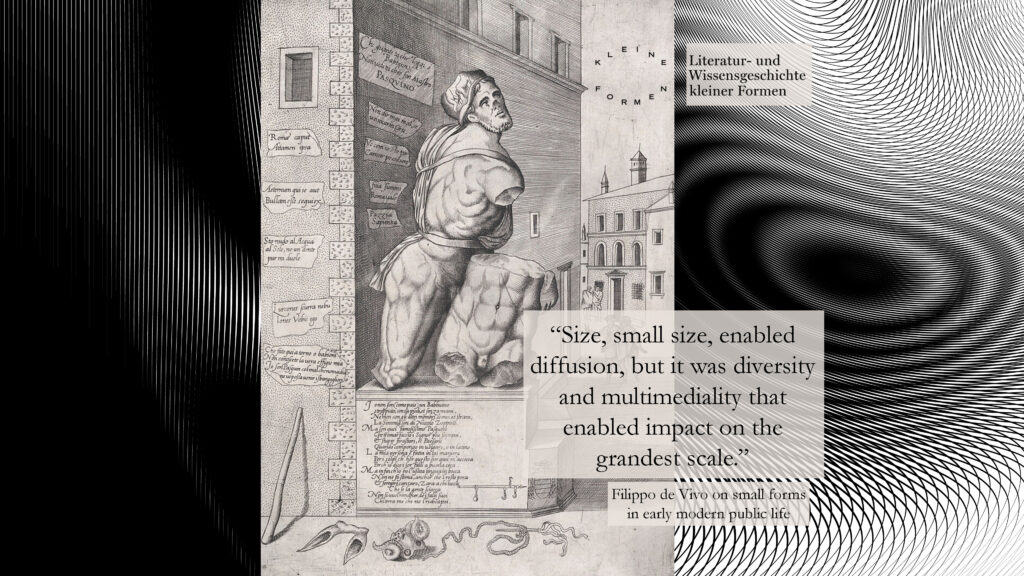
Image:
Pasquino, printed by Nicolas van Aelst, after Antonio Salamanca, c.1600. Engraving printed by Antoine Lafrery, 1570. 40 × 28 cm (plate), from: de Vivo, Filippo. “A Cock for the Records: Posted Libels as Archival Objects.” Journal of Early Modern History 29:4 (2025): 317–330. https://doi.org/10.1163/15700658-12342774.
Recommended citation:
“From streets to archive: pasquinades and libels between re-mediation and de-mediation”. Lecture by Filippo de Vivo, in: microform. Der Podcast des Graduiertenkollegs Literatur- und Wissensgeschichte kleiner Formen, available at: XXX, Berlin 2025 [Date of last access].
Credits
Moderation
Morten Schneider, Marie van Bömmel
Editing
Marie van Bömmel, Johann Gartlinger
Mastering
Johann Gartlinger
Music
„Karls Pultz“, „The Crisper“ and „Wilted“ from Blue Dot Sessions
Jingle and Stinger
Michael Hoeldke (composer), Cathrin Bonhoff (voice)
Social Media and Technical Support
Jasper Novak